When a storm damages your roof, your insurance company doesn’t always pay what it costs to replace it. Instead, they calculate something called actual cash value (ACV) — the replacement cost minus depreciation. Understanding how that depreciation number is determined can mean the difference between a fair settlement and a payout that leaves you thousands of dollars short.
This guide breaks down the math insurers use, the factors that drive depreciation higher or lower, and the steps you can take if you believe your depreciation calculation is wrong.
Key Takeaways
- ACV = Replacement Cost Value minus Depreciation. Your insurer subtracts depreciation from what a new roof would cost to arrive at your payout.
- Age and material type are the two biggest depreciation drivers. A 15-year-old asphalt shingle roof depreciates far more than a 15-year-old metal roof.
- Depreciation schedules vary by insurer. Most use an annual percentage rate tied to the material’s expected lifespan.
- RCV policies let you recover depreciation after repairs are completed. ACV-only policies do not.
- You can dispute a depreciation calculation using your own contractor estimate, a public adjuster, or the appraisal process.
- Roof condition at the time of loss matters. Pre-existing wear, missing granules, or prior storm damage can increase depreciation applied.
What Is Roof Insurance Depreciation and Why Does It Matter?
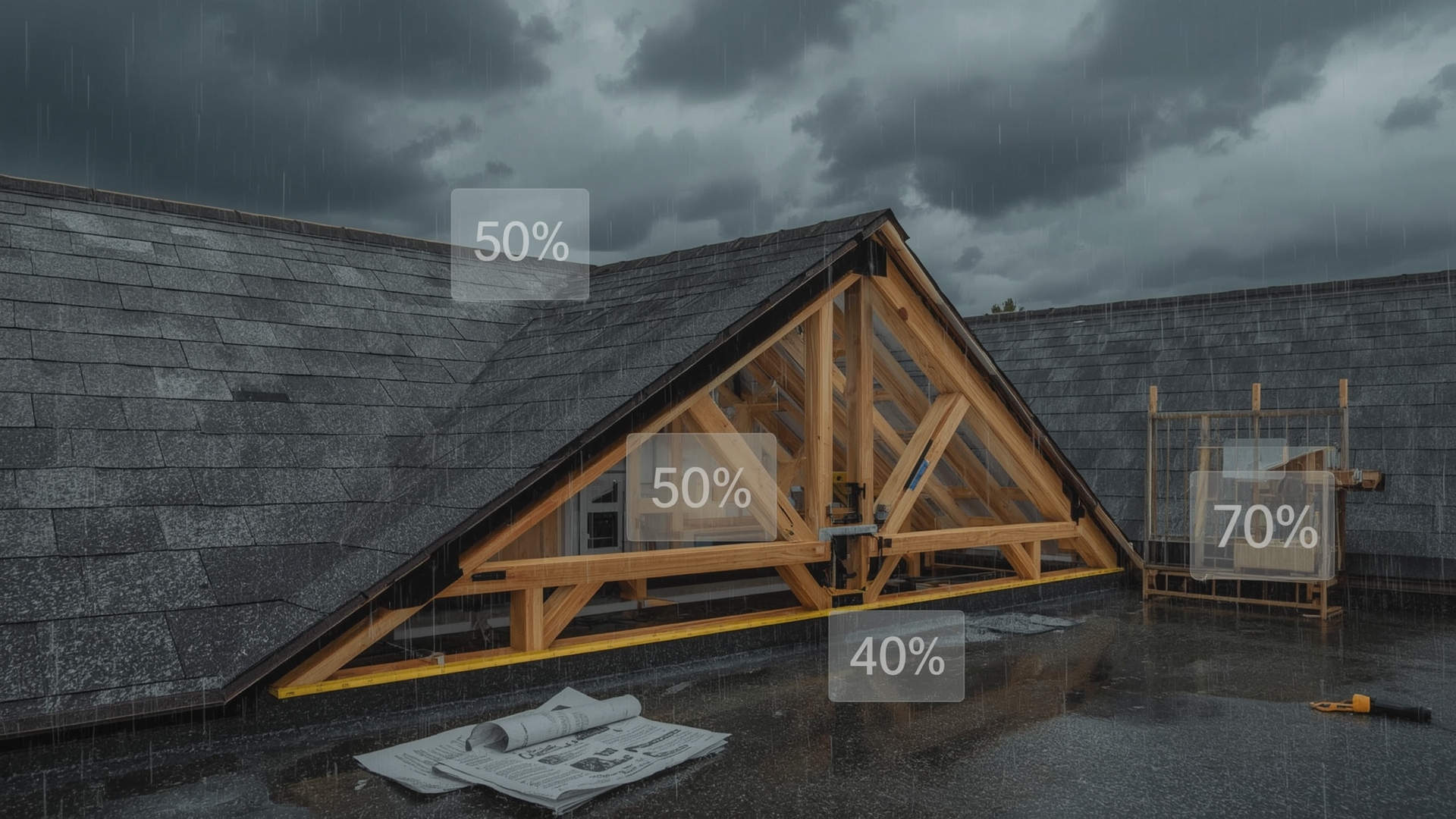
Quick Answer: Roof insurance depreciation is the reduction in your roof’s value due to age, wear, and material degradation. Insurers subtract this amount from replacement cost to calculate your actual cash value payout — often reducing your check by 30% to 70%.
Depreciation in insurance is not the same as tax depreciation. It reflects the idea that a 12-year-old roof has less value than a brand-new one. If your roof would cost $15,000 to replace and the insurer calculates 50% depreciation, your ACV payout is $7,500.
That gap matters enormously. On an ACV-only policy, $7,500 is all you get. On a replacement cost value (RCV) policy, you can recover the withheld depreciation once repairs are done. Knowing which policy you have — and how depreciation is being calculated — directly affects your financial outcome.
How Do Insurance Companies Calculate Roof Depreciation?
Quick Answer: Insurers calculate roof depreciation using a depreciation schedule based on the roof’s material, age, and expected useful life. They divide the age by the total lifespan, then multiply that percentage by the replacement cost to find the depreciation dollar amount.
The Basic Depreciation Formula
The most common method is straight-line depreciation. Here is how it works:
- Determine the replacement cost value (RCV) of the roof
- Identify the roof material’s expected useful life in years
- Calculate the age-to-life ratio: Roof Age ÷ Expected Life = Depreciation Percentage
- Multiply RCV by the Depreciation Percentage to get the depreciation dollar amount
- Subtract that amount from RCV to get the ACV payout
Worked Depreciation Example
Say you have a 10-year-old asphalt shingle roof. The insurer values replacement at $18,000. Asphalt shingles have an expected life of 20 years in their system.
- Age-to-life ratio: 10 ÷ 20 = 50%
- Depreciation amount: $18,000 × 50% = $9,000
- ACV payout: $18,000 − $9,000 = $9,000
That is a significant reduction. And the insurer’s numbers — their RCV estimate and their expected life figure — may not match the real world.
How Software Like Xactimate Factors In
Most large insurers use estimating software called Xactimate to calculate replacement costs. Xactimate pulls regional labor and material pricing to generate an RCV. Depreciation is then applied on top of that estimate. If the software underprices your region’s labor costs, your RCV starts lower — and so does your final ACV check.
What Factors Affect How Much Depreciation Is Applied to a Roof?
Quick Answer: The six main factors are roof age, material type, expected useful life, roof condition at the time of loss, geographic location, and whether the policy uses a flat depreciation schedule or a condition-based assessment. Each can significantly change the final depreciation amount.
Roof Material and Expected Lifespan
Every roofing material has a different expected lifespan. Insurers use these figures to set their depreciation schedules. A metal roof at year 15 has much lower depreciation than an asphalt shingle roof at year 15 — because metal is expected to last far longer.
| Roofing Material | Typical Expected Life (Insurer Schedule) | Annual Depreciation Rate | Depreciation at Year 15 | Maximum Depreciation Cap (Common) |
|---|---|---|---|---|
| 3-Tab Asphalt Shingles | 15–20 years | 5–6.7% per year | 75–100% | 80–90% |
| Architectural Asphalt Shingles | 20–25 years | 4–5% per year | 60–75% | 80% |
| Metal Roofing (Standing Seam) | 40–50 years | 2–2.5% per year | 30–37.5% | 70% |
| Clay or Concrete Tile | 30–40 years | 2.5–3.3% per year | 37.5–50% | 75% |
| Wood Shake | 20–25 years | 4–5% per year | 60–75% | 80% |
| Slate (Natural) | 75–100 years | 1–1.3% per year | 15–20% | 60% |
Roof Age and Documentation
If you cannot prove your roof’s age, the insurer may assume the worst. A permit or contractor receipt showing installation date is your best evidence. Without it, adjusters often estimate based on visible wear — which can skew older than the roof actually is.
Roof Condition at Time of Loss
Many insurers now use condition-based depreciation rather than pure age-to-life math. An adjuster or aerial imagery service like EagleView or Nearmap assesses the roof’s actual condition. Factors like granule loss, cracked shingles, moss growth, and sagging increase the depreciation applied — even if the roof is relatively new.
Geographic Location and Climate
Roofs in high-UV climates (Southwest U.S.) or freeze-thaw zones (Upper Midwest, Northeast) degrade faster. Some insurers apply accelerated depreciation schedules for these regions. A 12-year-old asphalt roof in Phoenix may receive higher depreciation than the same roof in Seattle.
Policy Type: ACV vs. RCV
This is the most important factor you control. With an ACV policy, depreciation is withheld permanently. With an RCV policy, depreciation is withheld until you complete repairs, then released as a second payment called recoverable depreciation. Many homeowners don’t realize which policy they hold until they file a claim.
What Is the Difference Between Recoverable and Non-Recoverable Depreciation?
Quick Answer: Recoverable depreciation is the withheld amount you can claim back after completing repairs under an RCV policy. Non-recoverable depreciation is permanently withheld — typically under an ACV policy or when an insurer classifies certain items as ineligible for recovery.
How Recoverable Depreciation Works
With an RCV policy, your insurer pays out ACV first. After you hire a contractor and complete the replacement, you submit your final invoice. The insurer then releases the withheld depreciation — as long as the actual repair cost meets or exceeds the RCV estimate.
The window to file for recoverable depreciation is typically 180 days to 2 years from the date of loss, depending on your policy. Missing this deadline means losing the withheld funds permanently.
What Makes Depreciation Non-Recoverable?
Some policies permanently exclude depreciation on certain items. Common non-recoverable depreciation situations include:
- Policies specifically written as ACV-only
- Roofs over a certain age threshold (some policies cap recovery at roofs older than 20 years)
- Cosmetic damage exclusions, where surface-level damage is deemed non-functional
- Items the insurer classifies as “betterment” — upgrades beyond like-kind-and-quality replacement
How Do Insurers Use Depreciation Schedules Differently?
Quick Answer: Each insurer maintains its own depreciation schedule — a table of material types, expected lifespans, and annual depreciation rates. These schedules vary widely. Two companies can apply different depreciation percentages to the same roof based on their internal guidelines.
Flat-Rate vs. Condition-Adjusted Schedules
Older depreciation models used a flat annual rate based purely on age. Newer approaches use condition-adjusted depreciation, blending age with observable wear. The condition-adjusted model typically produces higher depreciation for roofs with visible aging signs — even if they are within their expected lifespan.
Depreciation Caps
Most insurers apply a maximum depreciation cap so that even a very old roof retains some value. Common caps range from 70% to 90% depending on material and insurer. A 25-year-old asphalt roof with an 80% cap would receive 20% of its RCV as an ACV payout before the deductible is applied.
| Insurer Depreciation Method | Basis | Depreciation Transparency | Favors Policyholder When | Risk to Policyholder |
|---|---|---|---|---|
| Straight-Line Age-to-Life | Age ÷ Expected Life | High — predictable math | Roof is well-maintained for its age | Expected life set too low |
| Condition-Based Assessment | Physical inspection or aerial imagery | Medium — subjective inputs | Roof is in above-average condition | Adjuster overestimates wear |
| Hybrid (Age + Condition) | Both factors weighted | Low — formula not disclosed | Newer roof with minor wear | Opaque calculation process |
How Can You Calculate Roof Depreciation on Your Own?
Quick Answer: Get a written replacement cost estimate from a licensed roofing contractor. Then divide your roof’s age by its expected material lifespan to get a depreciation percentage. Multiply that percentage by the contractor’s RCV estimate to find the depreciation amount.
Step-by-Step: Running Your Own Calculation
- Get an independent contractor estimate. This establishes a real-world RCV based on local labor and material costs — not software averages.
- Confirm your roof’s age. Pull permits, original installation invoices, or prior inspection reports.
- Find the material’s expected lifespan. Use manufacturer documentation or published insurance industry schedules (many state insurance departments publish these).
- Apply straight-line depreciation. Age ÷ Expected Life × Contractor RCV = Depreciation Amount.
- Compare to the insurer’s calculation. If their RCV is lower than your contractor’s estimate, that gap is worth challenging.
Independent Estimate EAV Reference
| Roof Size | Material | Estimated RCV (2025 National Average) | Depreciation at Year 10 (20-year life) | Estimated ACV Payout |
|---|---|---|---|---|
| 1,500 sq ft (15 squares) | Architectural Asphalt | $12,000–$15,000 | 50% | $6,000–$7,500 |
| 2,000 sq ft (20 squares) | Architectural Asphalt | $16,000–$20,000 | 50% | $8,000–$10,000 |
| 2,000 sq ft (20 squares) | Standing Seam Metal | $30,000–$40,000 | 25% (at year 10 of 40-year life) | $22,500–$30,000 |
| 2,500 sq ft (25 squares) | Architectural Asphalt | $20,000–$25,000 | 50% | $10,000–$12,500 |
| 2,500 sq ft (25 squares) | Concrete Tile | $28,000–$35,000 | 37.5% (at year 15 of 40-year life) | $17,500–$21,875 |
How Can You Dispute a Roof Depreciation Calculation?
Quick Answer: You can dispute roof depreciation by gathering an independent contractor estimate, documenting the roof’s actual condition and installation date, requesting a line-by-line breakdown of the insurer’s calculation, and invoking the appraisal clause in your policy if negotiations stall.
Step 1: Request the Depreciation Breakdown
Ask your insurer in writing for a complete line-item explanation of how they calculated depreciation. This includes their assumed RCV, the expected lifespan they used for your material, and the depreciation percentage applied. You have the right to this information.
Step 2: Compare Their RCV Against a Real Contractor Estimate
Your insurer’s RCV may be based on outdated software pricing. A licensed roofing contractor’s written estimate reflects actual local labor rates and current material costs. If the contractor’s number is higher, that difference directly reduces how much depreciation you should owe.
Step 3: Document the Roof’s Actual Condition
If condition-based depreciation was applied, you can challenge it with evidence. Photos taken before the damage event, inspection reports, prior maintenance records, and manufacturer documentation all support your case. A roof that was professionally inspected and maintained two years before the loss should not receive the same depreciation as a neglected one.
Step 4: Challenge the Expected Lifespan Used
Insurers sometimes use conservative lifespan figures. If your asphalt shingles carry a manufacturer’s 30-year warranty but the insurer used a 20-year expected life in their calculation, that discrepancy increases your depreciation unfairly. Manufacturer warranty documentation is legitimate evidence in a dispute.
Step 5: Invoke the Appraisal Clause
Most homeowners insurance policies include an appraisal clause — a formal dispute mechanism. Both you and the insurer hire independent appraisers. Those appraisers select a neutral umpire. If the two appraisers cannot agree, the umpire decides. The appraisal process addresses both the value of the loss and the scope of damage, which affects depreciation calculations directly.
Step 6: Work With a Public Adjuster
A public adjuster is a licensed professional who represents policyholders — not the insurance company. They analyze your claim, identify undervalued line items, and negotiate on your behalf. Public adjusters typically charge 10% to 15% of the final settlement. On a large claim with significant under-depreciation, that fee often pays for itself.
What Are Common Mistakes Homeowners Make With Roof Depreciation Claims?
Quick Answer: The most common mistakes are accepting the first ACV offer without questioning the math, failing to document the roof’s condition before a loss event, not knowing their policy type, and missing the deadline to file for recoverable depreciation after completing repairs.
Accepting the First Offer Without Reviewing the Breakdown
Many homeowners treat the insurer’s first check as final. It is not. The initial payment is an ACV estimate, not a negotiated settlement. You have the right to question every number in the depreciation calculation before cashing that check.
Not Knowing Your Policy Type Before a Claim
Find out right now whether your policy is ACV or RCV. Call your agent and ask specifically: “Does my policy include replacement cost value coverage for my roof?” Some policies downgrade roof coverage to ACV-only after the roof reaches a certain age, even if the rest of the structure has RCV coverage.
Losing Track of the Recoverable Depreciation Deadline
After repairs are done on an RCV policy, many homeowners forget to submit the final invoice to their insurer. That withheld depreciation payment does not come automatically. You must actively request it within the policy’s deadline.
Skipping Pre-Loss Documentation
Annual roof photos and inspection reports are your best defense against inflated condition-based depreciation. If your roof looks clean and well-maintained in photos from 18 months before the storm, an adjuster cannot credibly argue it was in poor condition.
How Does Roof Age Affect Insurability and Depreciation Over Time?
Quick Answer: As a roof ages past 15 to 20 years, insurers apply higher depreciation percentages, and some carriers restrict coverage or require roof replacement before renewing the policy. Roofs over 25 years old may only qualify for ACV coverage regardless of condition.
Age Thresholds That Trigger Coverage Changes
| Roof Age | Typical Insurer Response | Coverage Impact | Depreciation Level | Renewal Risk |
|---|---|---|---|---|
| 0–5 years | Standard RCV coverage offered | Full replacement cost available | Low (0–25%) | Minimal |
| 6–10 years | RCV typically maintained | Full replacement cost available | Moderate (30–50%) | Low |
| 11–15 years | Some carriers begin condition inspections | RCV may require inspection to maintain | Moderate-High (50–70%) | Low-Medium |
| 16–20 years | Many carriers downgrade to ACV | Depreciation withheld permanently | High (65–85%) | Medium-High |
| 21–25 years | ACV-only or require replacement | Minimal payout on total loss | Very High (80–100%) | High |
| 25+ years | Non-renewal or exclusion common | Coverage may be denied or excluded | At or near cap | Very High |
Does Roof Material Quality Affect Your Insurance Depreciation Rate?
Quick Answer: Yes. Higher-quality roofing materials with longer manufacturer lifespans receive lower annual depreciation rates. A Class 4 impact-resistant shingle with a 30-year warranty depreciates more slowly than a standard 3-tab shingle — and may also qualify for a premium discount.
Material Quality, Lifespan, and Depreciation Rate Relationship
The longer a material is warranted to last, the lower the annual depreciation rate applied to it. This creates a compounding benefit for premium materials: they depreciate more slowly AND they tend to survive weather events with less damage, reducing the frequency of claims.
When choosing a new roof, ask your insurer how they classify your intended material on their depreciation schedule. Some carriers treat architectural shingles and premium designer shingles identically despite different manufacturer lifespans. Knowing this before installation helps you make an informed decision about whether upgrading to a longer-life material changes your depreciation exposure.
Frequently Asked Questions About Roof Insurance Depreciation
Can an insurance company depreciate a brand-new roof?
If you installed the roof just before the loss event, depreciation should be minimal. However, some insurers apply a small amount of depreciation even on roofs under one year old. Document your installation date and keep the contractor invoice. Present these immediately when filing your claim.
What is a depreciation holdback and when is it released?
A depreciation holdback is the amount withheld from your ACV payment under an RCV policy. It is released after you complete repairs and submit your final contractor invoice. The holdback is only paid up to the original RCV estimate — if your actual repair cost is lower, the holdback is reduced accordingly.
Does filing a roof claim affect future depreciation calculations?
Filing a claim does not change how depreciation is calculated — depreciation is based on age and condition, not claim history. However, claim history can affect your premium rates and whether a carrier will renew your policy. A second roof claim within a short period may trigger a coverage review.
Can I negotiate the expected lifespan the insurer uses?
Yes, with documentation. If your shingles carry a 30-year manufacturer warranty but your insurer used a 20-year expected life, present the warranty document and request a recalculation. Some insurers will adjust their expected lifespan when you provide manufacturer specifications in writing.
What does “functional depreciation” mean on an insurance estimate?
Functional depreciation refers to reduced value caused by wear that affects the roof’s performance — not just its appearance. Missing granules, cracked shingles, and degraded flashing are examples. Insurers use functional depreciation to justify higher deductions beyond simple age-to-life math. If disputed, you need a contractor or inspector to counter-document the roof’s actual functional condition.
Is there a state law that limits how much an insurer can depreciate a roof?
Some states have passed regulations restricting age-based roof depreciation or prohibiting ACV-only policies on roofs under a certain age. Florida, for example, has seen ongoing legislative activity around roof claim settlements. Check your state’s Department of Insurance website for current rules, as regulations vary significantly and change regularly.