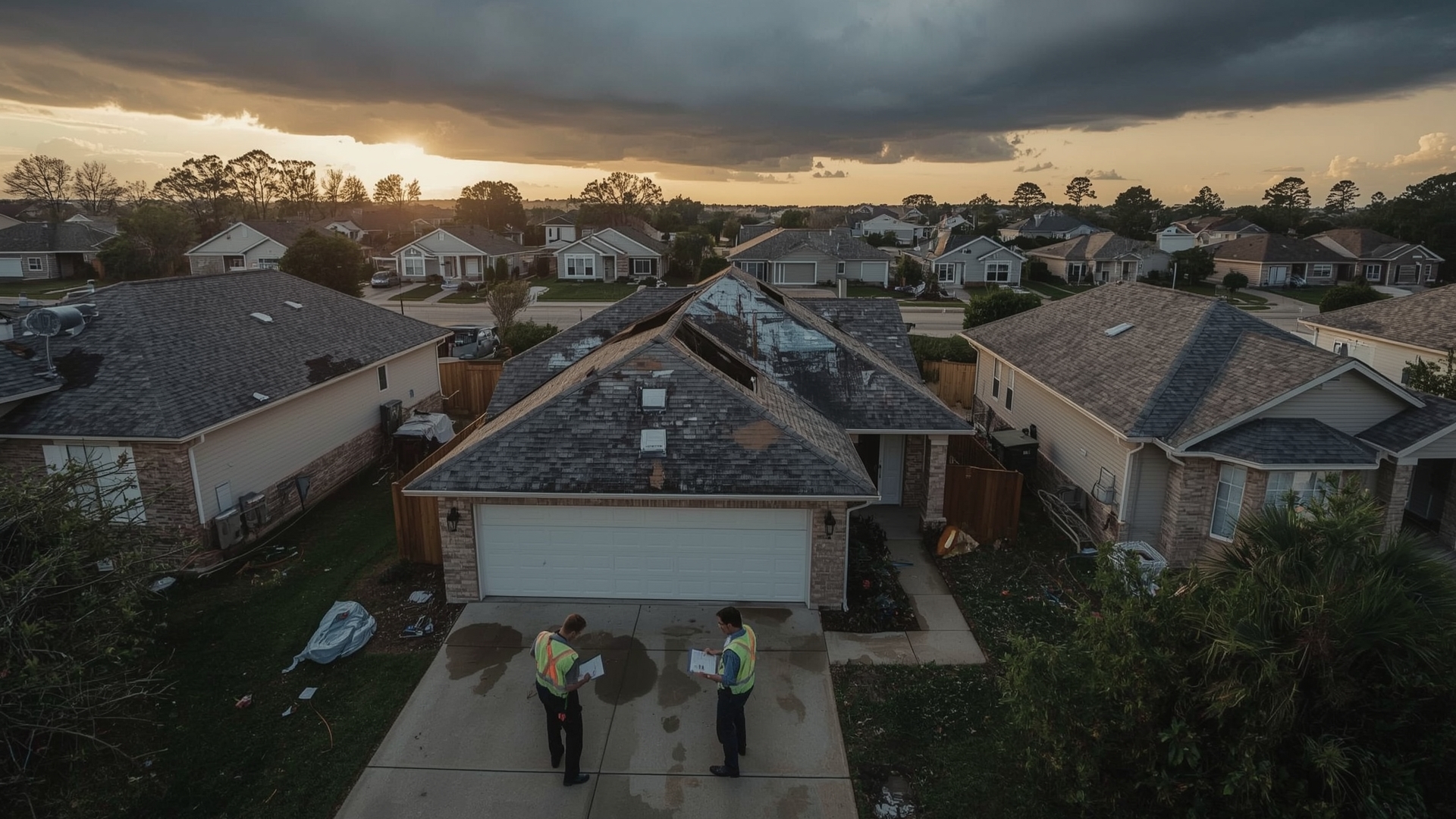
Your insurance company paid you less than your roof cost to replace. That difference is called withheld depreciation, and in most policies, you can get it back. The process is called recovering depreciation, and it starts the moment your repairs are complete.
Most homeowners never claim this money. They assume the first check was the final check. It is not. If your policy includes Replacement Cost Value (RCV) coverage, the insurance company holds back depreciation until you finish the work. Once you do, you submit proof and they release the remaining funds.
This guide walks you through every step, from understanding what depreciation recovery means to submitting the right documents before your deadline expires.
Key Takeaways
- RCV policies pay in two stages: an initial Actual Cash Value (ACV) check first, then the withheld depreciation after repairs are complete.
- You must complete repairs first before your insurer will release the depreciation holdback.
- Most insurers allow 6 to 24 months to submit your depreciation recovery claim after the loss date.
- The required documents are typically your final contractor invoice, proof of payment, and a completion certificate.
- State laws affect your deadline — some states extend or restrict the recovery window through specific regulations.
- Missing the deadline means forfeiting the money — insurers are not required to pay after the window closes.
- Supplements can be added at the same time you file for depreciation recovery if hidden damage was found during repairs.
What Is Recoverable Depreciation on a Roof Insurance Claim?
Quick Answer: Recoverable depreciation is the money your insurer withholds from your first payment. It equals the difference between your roof’s replacement cost and its depreciated value. You get this money back after you complete repairs and submit proof to your insurer.
When your insurance company processes a roof claim, they calculate two numbers. The first is Replacement Cost Value (RCV), which is what it costs to replace your roof with new materials at today’s prices. The second is Actual Cash Value (ACV), which is RCV minus depreciation.
Depreciation accounts for your roof’s age, condition, and wear. A 15-year-old asphalt shingle roof is not worth the same as a brand-new one, so the insurer subtracts value for those 15 years of use.
Your first check reflects the ACV. The withheld portion, the gap between ACV and RCV, is the recoverable depreciation. Think of it like a deposit the insurance company holds until you prove the work is done.
RCV vs. ACV: Which Policy Do You Have?
Not every policy allows depreciation recovery. You need an RCV policy, not an ACV policy. An ACV policy pays only the depreciated value and nothing more. Check your declarations page for the policy type before expecting a second payment.
| Attribute | RCV Policy | ACV Policy |
|---|---|---|
| First Payment | ACV (depreciation withheld) | ACV (final payment) |
| Second Payment Available | Yes, after repairs complete | No |
| Depreciation Recovery | Yes, recoverable | No, non-recoverable |
| Premium Cost | Higher (typically 10–20% more) | Lower |
| Best For | Newer roofs, full replacement coverage | Older roofs, lower premium priority |
How Much Depreciation Can You Recover on a Roof Claim?
Quick Answer: The amount you recover equals the difference between your insurer’s RCV estimate and the ACV check you already received, minus your deductible. On a $15,000 roof, this withheld amount commonly ranges from $2,000 to $6,000 depending on roof age.
The withheld depreciation varies by roof age, material, and your insurer’s depreciation schedule. Older roofs have more depreciation withheld because they have less remaining useful life.
| Roof Material | Typical Lifespan | Roof Age | Estimated Depreciation Rate | Withheld Depreciation | First Check (ACV) |
|---|---|---|---|---|---|
| 3-Tab Asphalt Shingles | 15–20 years | 5 years | 25% | $3,750 | $11,250 |
| Architectural Shingles | 25–30 years | 8 years | 27% | $4,050 | $10,950 |
| Metal Roofing | 40–70 years | 10 years | 15% | $2,250 | $12,750 |
| Wood Shake | 20–30 years | 12 years | 40% | $6,000 | $9,000 |
| Tile Roofing | 40–50 years | 15 years | 30% | $4,500 | $10,500 |
These estimates use straight-line depreciation, which is the most common method. Some insurers use condition-based depreciation, which adjusts for actual wear rather than age alone.
When Can You File for Depreciation Recovery After Roof Repairs?
Quick Answer: You can file for depreciation recovery as soon as your roof replacement is fully complete. Most insurers require you to submit your claim within 6 to 24 months of the original loss date, not the repair completion date.
Timing matters. Most policies set the deadline based on the date of loss, which is the date of the storm or event that damaged your roof. The clock starts ticking that day, not the day repairs finish.
If your policy gives you 12 months and your repair took 9 months, you have 3 months left to submit your recovery claim. This is why starting repairs quickly is in your financial interest.
Typical Deadlines by Insurer Type
| Insurer Type | Common Deadline | Deadline Basis | Extension Available |
|---|---|---|---|
| Large National Carriers (e.g., State Farm, Allstate) | 12 months | Date of loss | Sometimes, in writing |
| Regional Carriers | 6–12 months | Date of loss | Rarely |
| Farm Bureau Policies | 12–24 months | Date of loss | Case by case |
| Lloyd’s / Surplus Lines | 6 months | Date of loss | Rarely |
| State-Regulated Minimums (select states) | 24 months | Date of loss | Set by statute |
Always check Section I of your policy under “Loss Settlement” or “Conditions” for the exact language. If you are unsure, call your adjuster and ask directly: “What is my deadline to submit the recoverable depreciation claim?” Get the answer in writing.
What Documents Do You Need to Recover Roof Depreciation?

Quick Answer: To recover roof depreciation, you need your contractor’s final signed invoice, proof you paid in full, a certificate of completion, and photos of the finished roof. Some insurers also require a permit or inspection record.
Required Documentation Checklist
- Final contractor invoice: Must be itemized and match the scope of the original claim. Include labor, materials, and any approved supplements.
- Proof of payment: A canceled check, bank statement, credit card statement, or receipt showing you paid the contractor in full.
- Certificate of completion: A signed document from your contractor confirming the job is finished. Many insurers have their own form.
- Before and after photos: Dated photos showing the damaged roof and the completed replacement.
- Building permit and inspection record: Required in many municipalities. Some insurers ask for this to confirm code-compliant installation.
- Copy of your original claim documents: Your claim number, the insurer’s initial settlement letter, and the original Xactimate estimate (the line-by-line repair estimate your adjuster used).
What If Your Contractor Charged More Than the Insurer’s Estimate?
This is common. Material costs and labor rates fluctuate, and Xactimate estimates are not always current. If your invoice is higher than the insurer’s approved amount, submit a supplement claim at the same time as your depreciation recovery request.
A supplement is a formal request for additional payment based on documented costs that were not included in the original estimate. Attach your contractor’s invoice and a written explanation of the difference. Many insurers process supplements and depreciation recovery together.
How Do You Submit a Depreciation Recovery Claim Step by Step?

Quick Answer: Contact your insurer, notify them repairs are complete, gather your invoice and payment proof, submit everything through their portal or in writing, and follow up within 10 business days. The payout typically arrives within 2 to 4 weeks of submission.
Step 1: Confirm Your Policy Covers Recoverable Depreciation
Pull out your declarations page and your policy. Look for language like “Replacement Cost Coverage,” “RCV,” or “recoverable depreciation.” If it says “Actual Cash Value only,” stop here — your policy does not offer this option.
Step 2: Complete the Roof Repairs
You cannot file for depreciation recovery until the work is done. Partial repairs usually do not qualify. Complete the full scope of work outlined in the original claim, including any code-required upgrades covered by your policy.
Step 3: Collect All Required Documents
Gather the final invoice, proof of payment, completion certificate, photos, and permit records. Organize them into one submission package. Missing a single document can delay your payment by weeks.
Step 4: Contact Your Insurance Company
Call your claims adjuster or the insurer’s claims line. Inform them the repairs are complete and you are submitting a depreciation recovery request. Ask how they prefer to receive documents — email, online portal, fax, or mail. Confirm the deadline and get a name.
Step 5: Submit Your Documentation Package
Submit everything in one package, not piece by piece. Include a cover letter stating your claim number, the phrase “Recoverable Depreciation Release Request,” the date repairs were completed, and a list of enclosed documents. Keep copies of everything you send.
Step 6: Follow Up and Track the Review
Most insurers take 10 to 30 days to process a depreciation recovery request. Follow up after 10 business days if you have not received a response. Document every call with the date, time, and name of the representative you spoke with.
Step 7: Review the Final Payment
When the check arrives, compare it to the withheld depreciation amount shown in your original settlement letter. If there is a discrepancy, ask for a written explanation. Insurers sometimes apply an additional deductible or adjust the amount based on supplemental findings.
Do State Laws Affect Depreciation Recovery Timelines?
Quick Answer: Yes. Some states have enacted laws that set minimum timelines for depreciation recovery, restrict how much depreciation can be withheld, or require insurers to use specific calculation methods. Texas, Florida, and California each have notable rules.
Insurance is regulated at the state level. This means your recovery timeline and rights depend heavily on where you live, not just what your policy says.
| State | Minimum Recovery Window | Labor Depreciation Allowed | Notable Rule |
|---|---|---|---|
| Texas | 12 months (policy minimum) | No (HB 1774 limits some practices) | Insurers must provide itemized depreciation breakdown on request |
| Florida | 24 months (statute minimum) | Limited by Department of Financial Services guidance | Section 627.7011 governs RCV payment timing |
| California | 24 months (extended to 36 after disasters) | Not explicitly prohibited statewide | Insurers must offer extended periods after declared disasters |
| Colorado | 12 months (policy minimum) | Prohibited by statute (SB 10-038) | Labor cannot be depreciated — only materials |
| Oklahoma | 12 months | Allowed | No statutory restriction on depreciation method |
| Minnesota | 12–24 months | Regulated by Commissioner guidance | Unfair trade practice rules apply to depreciation disputes |
If your state is not listed, check with your state’s Department of Insurance. Many states publish homeowner guides that explain your rights during the claims process.
What Is Labor Depreciation and Why Does It Matter?
Some insurers depreciate both the materials and the labor cost of your roof replacement. Labor depreciation reduces your ACV check further, leaving more withheld until repairs are done. Colorado prohibits this practice entirely. If you live in a state that allows it, your initial check may be lower than expected, but the recoverable amount will be higher.
What Happens If Your Insurer Disputes the Depreciation Recovery Amount?
Quick Answer: If your insurer underpays or denies your depreciation recovery request, you can request a written explanation, file an internal appeal, invoke the appraisal clause in your policy, or file a complaint with your state’s Department of Insurance.
Request a Written Explanation First
Ask your insurer to provide a line-by-line explanation of how they calculated the final depreciation payout. Compare their numbers to the original Xactimate estimate and your final invoice. Look for discrepancies in unit prices, line items that were removed, or deductions that were not in the original settlement.
Use the Appraisal Clause If Needed
Most homeowners insurance policies include an appraisal clause. This is a built-in dispute resolution process. Both you and the insurer hire independent appraisers. The two appraisers then agree on an umpire. The umpire resolves any disagreements. This process avoids litigation and often resolves disputes within 30 to 90 days.
File a Complaint With Your State Department of Insurance
If the insurer is unresponsive or acting in bad faith, file a formal complaint with your state’s Department of Insurance. Bad faith behavior includes refusing to explain denials, unreasonable delays, or misrepresenting your policy terms. Most states respond to complaints within 30 days and can compel the insurer to respond.
Can You Recover Depreciation If You Did Not Use All of the First Check?
Quick Answer: Yes, you can still recover depreciation even if you did not spend the full ACV check. What matters is that you completed the repairs and paid for them. The insurer releases the withheld amount based on completion, not on how you managed the initial payment.
Some homeowners get a contractor to do the job for less than the ACV check amount. That is allowed. The withheld depreciation still gets paid out once you prove the work is done. You keep the difference between the ACV check and the actual repair cost, and you also receive the depreciation recovery on top.
However, if repairs were not completed at all, the insurer will not release the depreciation. They need proof of actual repairs, not just intent.
Do You Need a Public Adjuster to Recover Roof Depreciation?
Quick Answer: You do not need a public adjuster to file a depreciation recovery claim. Most homeowners can do this themselves. A public adjuster becomes valuable when the withheld amount is disputed, when the insurer is unresponsive, or when a supplement claim is also needed.
A public adjuster is a licensed professional who represents you, not the insurance company, during the claims process. They typically charge a fee of 5% to 15% of the total claim payout. On a $5,000 depreciation recovery, that fee could be $250 to $750.
For a straightforward recovery with clear documentation, handling it yourself is reasonable. For complex situations — older roofs, disputed scopes, or unresponsive insurers — a public adjuster can recover more than enough to justify their fee.
What Are the Most Common Mistakes Homeowners Make When Filing for Depreciation Recovery?

Quick Answer: The most common mistakes are missing the deadline, submitting incomplete documents, not tracking correspondence, and failing to check whether a supplement is also needed. Each of these can delay or permanently forfeit your payout.
Mistake 1: Missing the Submission Deadline
This is the most costly error. Once the deadline passes, the insurer is not required to pay. Set a calendar reminder the day you receive your first check. Your deadline starts on the date of loss, not the date of payment.
Mistake 2: Submitting Incomplete Documentation
A missing proof of payment or unsigned invoice can put your claim on hold for weeks. Build a complete documentation package before you submit anything.
Mistake 3: Not Checking for Supplements
If the contractor found additional damage during repairs, that needs to be documented and added as a supplement. Submitting the supplement with your depreciation recovery request saves time and creates a clean record.
Mistake 4: Accepting a Reduced Payout Without Questioning It
Insurers sometimes pay less than the full withheld depreciation without explanation. Always compare the payment to the original settlement breakdown. If numbers do not match, ask for a written justification before accepting.
Mistake 5: Not Keeping Records of All Communications
Every phone call, email, and letter should be logged. If a dispute arises, your communication records are your evidence. Keep dates, times, and names of every insurer representative you contact.
Frequently Asked Questions
What if my insurer says I missed the depreciation recovery deadline?
Ask for the deadline language in writing, directly from your policy. If there is any ambiguity, request a written denial and contact your state’s Department of Insurance. Some states do not allow insurers to set deadlines shorter than 12 to 24 months, so your insurer’s stated deadline may not be legally enforceable.
Can I recover depreciation if I used a different contractor than the one who gave the original estimate?
Yes. You can use any licensed contractor. The insurer cares about proof of completed repairs, not about which contractor did the work. Just make sure the final invoice clearly shows the work completed matches the approved claim scope.
Does my mortgage lender get involved in the depreciation recovery payment?
Possibly. If your home has a mortgage, your lender may be listed as a co-payee on insurance claim checks, including depreciation recovery payments. You may need your lender’s signature or endorsement before you can cash the check. Contact your mortgage servicer as soon as you receive any insurance payment to avoid delays.
What is an Xactimate estimate and why does it matter for my claim?
Xactimate is the industry-standard software that insurance adjusters use to calculate repair costs. It generates a line-by-line breakdown of your claim, including materials, labor, and overhead. Your depreciation is calculated based on these line items. Reviewing your Xactimate report helps you spot errors or low estimates before you accept any payment.
Can I recover depreciation if my roof was only partially replaced?
It depends on your policy and the claim scope. If your adjuster approved a partial replacement, completing that approved scope qualifies you for depreciation recovery on those sections. If you completed only a portion of what was approved, the insurer may pay partial depreciation recovery proportional to the completed work.
What happens to the withheld depreciation if I sell my home before completing repairs?
If you sell the home before completing repairs, you typically forfeit the withheld depreciation. The insurer will not release it because the repairs were never completed. In some cases, buyers and sellers negotiate who is responsible for the repair completion and the insurance claim as part of the sale agreement. Always disclose an open insurance claim during a real estate transaction.