A roof replacement is one of the biggest home expenses you’ll face. Most homeowners have no idea what to expect when they start calling contractors — and that uncertainty leads to overpaying, underplanning, or getting the wrong roof entirely.
This guide breaks down every cost factor: material type, roof size, labor rates, removal fees, and the extras that catch people off guard. By the end, you’ll know exactly what to ask for and what to watch out for.
Key Takeaways
- Average total cost: Most homeowners pay between $8,000 and $20,000 for a full roof replacement on a standard home.
- Material choice drives cost: Asphalt shingles are the most affordable option. Metal and tile cost significantly more but last longer.
- Labor is 40–60% of your bill: Contractor labor typically makes up nearly half of your total project cost.
- Roof size matters more than square footage: Roofing is priced by the “square” (100 sq ft), not your home’s floor plan size.
- Insurance may cover part of it: Storm damage, hail, and wind are commonly covered — age-related wear is usually not.
- Get at least three quotes: Prices vary widely between contractors. Multiple bids protect you from overpaying.
What Is the Average Cost of a Roof Replacement?
Quick Answer: A typical roof replacement costs between $8,000 and $20,000 for a standard single-family home. The national average lands around $11,500. Final cost depends on roof size, materials, labor rates, and local market conditions.
Most homeowners are surprised by how wide the price range is. A small home with basic asphalt shingles in a low-cost market might come in around $6,000. A large home with a steep pitch in a metro area using premium materials can push past $30,000.
Understanding what drives that range is the key to budgeting accurately.
How Does Home Size Affect Total Roof Cost?
Roofing contractors don’t price jobs by your home’s floor plan. They price by the roof surface area, measured in “squares.” One square equals 100 square feet of roof surface.
A 2,000-square-foot home doesn’t automatically have a 2,000-square-foot roof. Roof pitch (steepness), overhangs, dormers, and valleys all add surface area. A typical 2,000 sq ft home often has a roof measuring 22 to 28 squares.
Roof Size to Square Estimate
| Home Size (sq ft) | Estimated Roof Squares | Low-End Cost (Asphalt) | High-End Cost (Premium) |
|---|---|---|---|
| 1,000–1,500 | 12–18 squares | $5,500–$8,000 | $15,000–$22,000 |
| 1,500–2,000 | 18–24 squares | $7,500–$11,000 | $20,000–$30,000 |
| 2,000–2,500 | 22–30 squares | $9,500–$14,000 | $25,000–$38,000 |
| 2,500–3,500 | 28–40 squares | $13,000–$18,000 | $32,000–$50,000 |
How Much Do Different Roofing Materials Cost?

Quick Answer: Asphalt shingles cost $3.50–$6.50 per square foot installed. Metal roofing runs $7–$18 per square foot. Tile (clay or concrete) costs $10–$25 per square foot. Material choice is the single biggest cost variable after roof size.
Each material has a different price per square foot, a different lifespan, and different long-term value. Cheaper upfront doesn’t always mean cheaper over time.
Asphalt Shingles
Asphalt shingles are installed on roughly 80% of American homes. They’re affordable, widely available, and easy for contractors to install quickly. Three-tab shingles are the most basic option. Architectural (dimensional) shingles cost slightly more but last longer and look better.
Impact-resistant shingles (Class 4 rated) cost 10–20% more but can lower your homeowner’s insurance premium in hail-prone states.
Metal Roofing
Metal roofs include standing seam steel, corrugated steel panels, and metal shingles. Standing seam is the premium option — panels interlock and have no exposed fasteners, which reduces leak risk. Steel and aluminum are the most common metals used.
Metal lasts 40–70 years versus 15–30 for asphalt. The higher upfront cost often makes sense if you plan to stay in the home long-term or want a low-maintenance option.
Tile Roofing
Clay tile and concrete tile are common in the Southwest, Florida, and California. They’re extremely durable (50–100 years) and fire-resistant. The downside is weight. Clay tile weighs 600–1,000 lbs per square. Your home’s structure may need reinforcement before installation, adding $1,000–$10,000 to the project.
Roofing Material Cost Comparison (EAV Table)
| Material | Cost Per Sq Ft (Installed) | Lifespan | Wind Rating | Fire Rating | Best For |
|---|---|---|---|---|---|
| 3-Tab Asphalt | $3.50–$5.00 | 15–20 years | 60–70 mph | Class A | Budget replacements |
| Architectural Asphalt | $4.50–$6.50 | 25–30 years | 110–130 mph | Class A | Most homeowners |
| Standing Seam Metal | $12–$18 | 40–70 years | 140–160 mph | Class A | Long-term value, coastal areas |
| Metal Shingles | $7–$12 | 40–60 years | 120–150 mph | Class A | Metal look at lower cost |
| Clay Tile | $15–$25 | 50–100 years | 125–150 mph | Class A | Southwest, Mediterranean style |
| Concrete Tile | $10–$18 | 40–50 years | 125–150 mph | Class A | Florida, California climates |
| Cedar Wood Shake | $8–$14 | 20–30 years | 80–100 mph | Class B or C | Aesthetic appeal, dry climates |
What Labor Costs Go Into a Roof Replacement?
Quick Answer: Labor accounts for 40–60% of a roof replacement bill. On a $12,000 job, that’s $4,800 to $7,200. Rates vary by region, roof complexity, and season. Steep roofs and multi-story homes cost more to labor because they take longer and carry more risk.
Labor costs aren’t just for nailing shingles. The crew handles tear-off (removing old roofing), decking inspection and repair, underlayment installation, flashing work, and final cleanup. Each step adds time.
What Affects Labor Rates the Most?
Roof pitch is the biggest labor variable. A low-slope roof (4:12 or less) is easy to walk on. A steep-slope roof (8:12 or greater) requires safety harnesses, slower movement, and more crew. Contractors typically charge a steep-slope premium of $0.50–$2.00 more per square foot.
Location matters too. Labor rates in the Northeast and West Coast run 20–40% higher than the Midwest and Southeast. A 25-square roof job might cost $3,500 in labor in Kansas City and $5,500 in Boston.
Labor Cost Breakdown by Roof Complexity
| Complexity Factor | Description | Additional Labor Cost |
|---|---|---|
| Low-slope pitch (2:12–4:12) | Easy walk, standard speed | Base rate, no premium |
| Moderate pitch (5:12–7:12) | Moderate effort, some harness use | +$0.50–$1.00/sq ft |
| Steep pitch (8:12–12:12) | Full harness required, slower work | +$1.00–$2.00/sq ft |
| Multi-story home | Longer setup, safety scaffolding | +$500–$1,500 flat |
| Multiple valleys/dormers | Complex cuts, custom flashing | +$200–$800 per feature |
| Skylights (per unit) | Flashing removal and reinstall | +$150–$400 each |
What Extra Costs Come With a Roof Replacement?
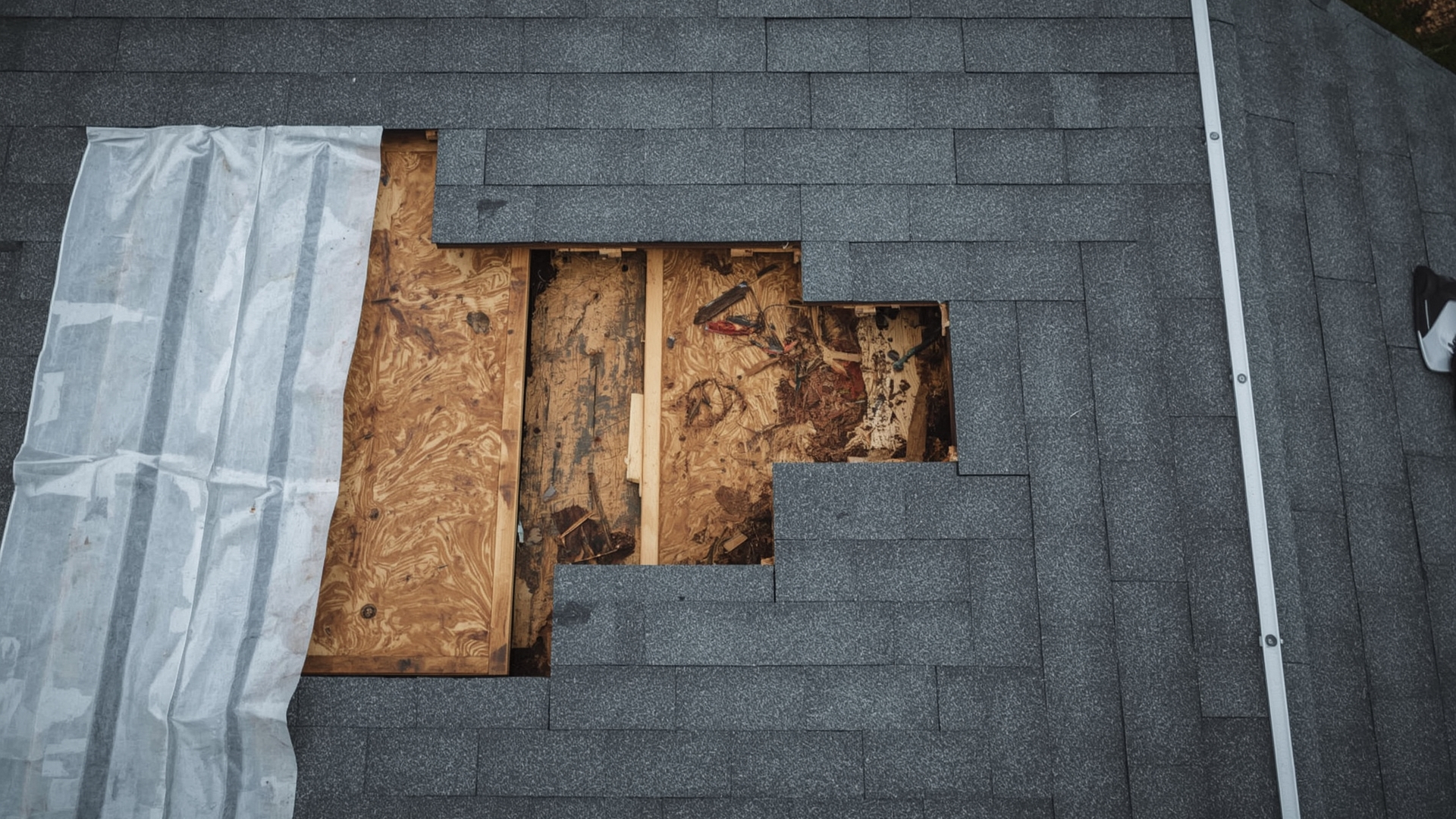
Quick Answer: Common add-on costs include old roof tear-off ($1–$2 per sq ft), damaged decking repair ($70–$100 per sheet), new underlayment, drip edge, pipe boots, and permit fees. Budget an extra 10–20% for unexpected repairs once the old roof comes off.
Contractors often give quotes that cover basic material and labor. Once the old shingles come off, they find damaged or rotted decking underneath. That’s where costs climb unexpectedly.
Tear-Off and Disposal
Removing and hauling away your old roof costs $1.00–$2.00 per square foot. On a 25-square roof, that’s $2,500–$5,000. Some quotes include this. Many don’t. Always ask before signing.
Some contractors offer a “lay-over” option, where they install new shingles directly over the old layer. This saves on tear-off but shortens the new roof’s lifespan and may violate local building codes. Most experts recommend against it.
Decking Repair
Roof decking is the plywood or OSB (oriented strand board) layer beneath the shingles. Water damage, rot, or age can weaken it. Replacing one sheet of 4×8 plywood costs $70–$120 in materials and labor. A badly damaged roof might need 10–30 sheets replaced, adding $700–$3,600 to the bill.
Additional Components and Their Costs
| Component | Purpose | Typical Cost |
|---|---|---|
| Underlayment (felt or synthetic) | Moisture barrier beneath shingles | $0.15–$0.65/sq ft |
| Ice and water shield | Protects eaves in cold climates | $0.75–$1.50/sq ft (eave areas) |
| Drip edge | Metal edge that directs water off roof | $1–$2/linear ft |
| Ridge cap shingles | Covers peak of roof | $2–$4/linear ft |
| Pipe boots/flashing | Seals around vents and pipes | $20–$60 per penetration |
| Ridge ventilation | Improves attic airflow, reduces heat | $300–$600 total |
| Building permit | Required in most municipalities | $150–$500 |
| Decking replacement | Rotted or damaged plywood sheets | $70–$120 per sheet |
Does Homeowner’s Insurance Cover Roof Replacement?
Quick Answer: Homeowner’s insurance covers roof replacement when damage comes from a sudden event — hail, wind, fallen trees, or fire. It does not cover gradual wear, age-related deterioration, or lack of maintenance. Your deductible, typically $1,000–$2,500, comes out of pocket first.
Filing a claim starts with documenting damage. Take photos of damaged shingles, dents, missing sections, and any water intrusion inside. Call your insurer before hiring a contractor. Most insurers send an adjuster to inspect the damage and issue an estimate.
Actual Cash Value vs. Replacement Cost Value
Your policy pays out in one of two ways. Actual Cash Value (ACV) policies pay for the roof’s current depreciated value. A 15-year-old roof that originally cost $10,000 might only receive $4,000 under an ACV policy.
Replacement Cost Value (RCV) policies pay what it costs to replace the roof with similar materials at today’s prices. RCV policies cost more in monthly premiums but protect you far better at claim time. Check your declarations page to confirm which you have.
How to Maximize Your Insurance Claim
Document everything before cleanup. Keep all contractor invoices, material receipts, and communication with your adjuster. Get your own contractor’s estimate independently — adjuster estimates are sometimes lower than actual contractor prices. You can negotiate or request a re-inspection if the numbers don’t align.
Impact-resistant shingles (Class 3 or Class 4 rated) may qualify you for a policy discount of 10–30% in states like Texas, Colorado, and Oklahoma, where hail is common.
How Do You Calculate the Right Roof Size for Your Quote?
Quick Answer: Multiply your home’s footprint length by width to get base square footage. Add 10–20% for roof pitch and overhangs. Divide by 100 to get total squares. A 2,000 sq ft footprint with a medium pitch typically yields 22–26 roofing squares.
You can also use satellite measurement tools. Many contractors use software like EagleView or Hover to measure roof surfaces remotely. These tools are accurate to within 1–2%, which is good enough for quoting.
Pitch Factor Multipliers
Pitch is the ratio of vertical rise to horizontal run. A 4:12 pitch rises 4 inches for every 12 inches of horizontal distance. Higher pitches increase the actual roof surface area compared to the floor plan area below.
| Roof Pitch | Pitch Description | Area Multiplier | Example (2,000 sq ft base) |
|---|---|---|---|
| 2:12–3:12 | Low slope, nearly flat | 1.02–1.07 | 2,040–2,140 sq ft roof |
| 4:12–5:12 | Moderate, common suburban | 1.08–1.16 | 2,160–2,320 sq ft roof |
| 6:12–7:12 | Medium-steep | 1.20–1.30 | 2,400–2,600 sq ft roof |
| 8:12–10:12 | Steep, Cape Cod style | 1.36–1.54 | 2,720–3,080 sq ft roof |
| 12:12+ | Very steep | 1.73+ | 3,460+ sq ft roof |
How Do You Get Accurate Quotes From Roofing Contractors?
Quick Answer: Get at least three written quotes from licensed, insured contractors. Each quote should itemize material type, square count, labor, tear-off, and warranty terms. Never accept a verbal estimate, and avoid contractors who demand full payment upfront before any work begins.
Start by searching for contractors with verified reviews on Google, Houzz, or the Better Business Bureau. Ask neighbors who recently had work done. Local roofing supply stores often know which contractors do consistent quality work.
What Should a Roofing Quote Include?
A legitimate, detailed quote covers more than just a bottom-line number. It should specify the exact shingle brand and product line (not just “architectural shingles”), the number of squares being installed, tear-off and disposal costs, whether permit fees are included, warranty coverage for both materials and workmanship, and a payment schedule tied to milestones.
Workmanship warranties range from 1 year (bare minimum) to 25 years (premium contractors). The shingle manufacturer’s warranty covers defects in the product itself, typically 25–50 years depending on the product tier.
Red Flags to Watch For When Hiring a Contractor
- No physical address or local license: Storm chasers often arrive after major weather events with no local accountability.
- Pressure to sign immediately: Reputable contractors don’t use high-pressure tactics or “today only” pricing.
- Full payment upfront: A reasonable deposit is 10–30% of the project total. Never pay in full before the job starts.
- No written warranty: Any contractor unwilling to put the warranty in writing is one to avoid.
- Unusually low bids: A quote significantly below all others usually means shortcuts in materials, labor, or both.
- Asking you to sign over insurance rights: Assignment of Benefits (AOB) agreements can complicate your claim and remove your control over the process.
How Does Roof Pitch and Complexity Affect Total Price?
Quick Answer: Steep pitches (8:12 and above) can add 20–40% to your total cost. Each additional valley, dormer, or skylight adds $200–$800 in labor. A complex roof with many angles costs significantly more than a simple gable roof of the same square footage.
A simple gable roof has two flat planes meeting at a ridge. It’s fast and inexpensive to install. A hip roof has four sloping sides, more valleys, and more complex flashing work. Cottage-style and Victorian homes with multiple dormers and intersecting angles can cost 30–50% more per square than a plain gable on the same-sized house.
Roof Style Cost Comparison
Complexity adds time, and time adds cost. Here’s how common roof styles compare on a 25-square roof with architectural asphalt shingles:
- Simple gable roof: $9,000–$12,000
- Hip roof: $11,000–$15,000
- Gambrel (barn-style): $12,000–$16,000
- Mansard: $14,000–$20,000
- Multi-gable or complex intersecting: $15,000–$25,000+
When Is the Best Time of Year to Replace a Roof?
Quick Answer: Late spring through early fall is the ideal window for roof replacements. Temperatures between 40°F and 85°F allow asphalt shingles to seal properly. Winter installs are possible but may cost more and carry higher risk of improper sealing in cold climates.
Roofing season peaks from May through September. Contractors are busiest (and sometimes booked out 4–8 weeks) during this window. Booking in late winter or early spring often gets you a faster start and sometimes a lower price, as contractors fill slower months.
Emergency replacements after storm damage happen year-round. If you’re dealing with active leaking, don’t wait for the right season. Temporary tarping and quick repairs can protect your home while you plan a proper replacement.
How Do You Finance a Roof Replacement?
Quick Answer: Common financing options include home equity loans (HELOC), personal loans, FHA Title I home improvement loans, contractor financing programs, and credit cards for smaller amounts. A HELOC typically offers the lowest interest rate since it’s secured by your home’s equity.
Many roofing contractors partner with financing companies like GreenSky, Synchrony, or Service Finance. These programs offer 12–18 months of deferred interest or fixed monthly payments. Read the fine print carefully — deferred interest means you owe all accumulated interest if you don’t pay off the balance before the promo period ends.
FHA Title I loans are federally backed and don’t require equity in your home. They’re capped at $25,000 for a single-family home and require repayment over 15–20 years. They’re a solid option if you have limited equity but need a new roof.
Frequently Asked Questions About Roof Replacement Costs
How long does a roof replacement take?
Most standard residential roof replacements take one to three days. A 25-square asphalt shingle job on a simple gable roof often wraps up in a single day with a full crew. Complex roofs, large homes, or tile installations may take three to five days.
Can I replace just part of my roof instead of the whole thing?
Partial replacements are possible when damage is confined to one section. However, matching existing shingles to discontinued colors or textures is difficult. Insurance companies also sometimes require a full replacement if the damage is widespread or if the roof has passed its useful life.
What is a roofing square and how do I use it to compare quotes?
One roofing square equals 100 square feet of roof surface area. Contractors price materials and labor per square. When comparing quotes, ask each contractor for their square count so you’re comparing identical scope. A lower price per square doesn’t help if one contractor is measuring fewer squares than another.
Does roof replacement increase home value?
Yes. A new roof typically adds $12,000–$20,000 in resale value, though the exact return varies by market, material, and buyer demand. According to Remodeling Magazine’s Cost vs. Value report, asphalt shingle replacements return roughly 60–65% of the project cost at resale. Metal roofs and premium materials may return more in higher-end markets.
What is the difference between a roofing warranty and a manufacturer’s warranty?
A manufacturer’s warranty covers defects in the roofing product itself. It’s tied to the shingle brand (like GAF, Owens Corning, or CertainTeed) and typically runs 25–50 years. A workmanship warranty covers the contractor’s installation quality. These range from 1 year to lifetime coverage, depending on the contractor’s certification level with the manufacturer.
What is flashing and why does it matter for roof replacement cost?
Flashing is thin metal (usually aluminum or galvanized steel) installed at roof joints, valleys, chimneys, vents, and skylights. It prevents water from entering at these vulnerable points. Replacing or repairing flashing adds $200–$1,500 to a job depending on how many penetrations and transition points your roof has. Skipping flashing replacement on an old roof is a common cause of post-installation leaks.